Twelve Days of Christmas Info
The Twelve Days of Christmas, also known as Twelvetide, is a festive Christian season celebrating the Nativity of Jesus. In most Western ecclesiastical traditions, "Christmas Day" is considered the "First Day of Christmas" and the Twelve Days are 25 December – 5 January, inclusive.For many Christian denominations—for example, the Anglican Communion and Lutheran Church—the Twelve Days are identical to Christmastide, but for others, e.g., the Roman Catholic Church, Christmastide lasts longer than the Twelve Days of Christmas.

| Observed by | Christians |
|---|---|
| Type | Christian |
| Observances | Varies by denomination, culture, and nation |
| Date | 25 December – 5 January, inclusive |
| Frequency | annual |
History
In 567, the Council of Tours "proclaimed the twelve days from Christmas to Epiphany as a sacred and festive season, and established the duty of Advent fasting in preparation for the feast." Christopher Hill, as well as William J. Federer, states that this was done in order to solve the "administrative problem for the Roman Empire as it tried to coordinate the solar Julian calendar with the lunar calendars of its provinces in the east."
 |
| Meaning behind the 12 Days of Christmas |
 |
12 Days of Christmas ImageEastern Christianity
In the Armenian Apostolic Church and Armenian Catholic Church celebrate the Birth and Baptism of Christ on the same day,so that there is no distinction between a feast of Christmas and a feast of Epiphany.
The Oriental Orthodox (other than the Armenians), the Eastern Orthodox, and the Eastern Catholics who follow the same traditions have a twelve-day interval between the two feasts. Christmas and Epiphany are celebrated by these churches on 25 December and 6 January using the Julian calendar, which correspond to 7 January and 19 January using the Gregorian calendar. The Twelve Days, using the Gregorian calendar, end at sunset on 18 January.
Eastern Orthodoxy
For the Eastern Orthodox, both Christmas and Epiphany are among the Twelve Great Feasts that are only second to Easter in importance.
The period between Christmas and Epiphany is fast-free. During this period one celebration leads into another. The Nativity of Christ is a three-day celebration: the formal title of the first day (i. e. Christmas Eve) is "The Nativity According to the Flesh of our Lord, God and Saviour Jesus Christ", and celebrates not only the Nativity of Jesus, but also the Adoration of the Shepherds of Bethlehem and the arrival of the Magi; the second day is referred to as the "Synaxis of the Theotokos", and commemorates the role of the Virgin Mary in the Incarnation; the third day is known as the "Third Day of the Nativity", and is also the feast day of the Protodeacon and Protomartyr Saint Stephen. 29 December is the Orthodox Feast of the Holy Innocents. The Afterfeast of the Nativity (similar to the Western octave) continues until 31 December (that day is known as the Apodosis or "leave-taking" of the Nativity).
The Saturday following the Nativity is commemorated by special readings from the Epistle (1 Tim 6:11-16) and Gospel (Matt 12:15-21) during the Divine Liturgy. The Sunday after the Nativity has its own liturgical commemoration in honour of "The Righteous Ones: Joseph the Betrothed, David the King and James the Brother of the Lord".
Another of the more prominent festivals that are included among the Twelve Great Feasts is that of the Circumcision of Christ on 1 January. On this same day is the feast day of Saint Basil the Great, and so the service celebrated on that day is the Divine Liturgy of Saint Basil.
On 2 January begins the Forefeast of the Theophany. The Eve of the Theophany on 5 January is a day of strict fasting, on which the devout will not eat anything until the first star is seen at night. This day is known as Paramony (Greek Παραμονή "Eve"), and follows the same general outline as Christmas Eve. That morning is the celebration of the Royal Hours and then the Divine Liturgy of Saint Basil combined with Vespers, at the conclusion of which is celebrated the Great Blessing of Waters, in commemoration of the Baptism of Jesus in the Jordan River. There are certain parallels between the hymns chanted on Paramony and those of Good Friday, to show that, according to Orthodox theology, the steps that Jesus took into the Jordan River were the first steps on the way to the Cross. That night the All-Night Vigil is served for the Feast of the Theophany.
 |

Icon Of The Twelve Great Feast Image
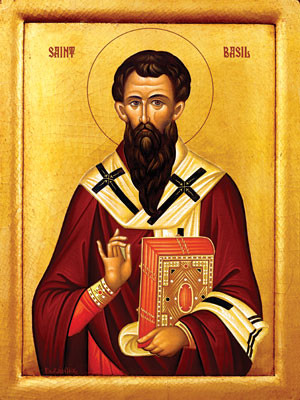 |
Icon of Saint Basil The Great image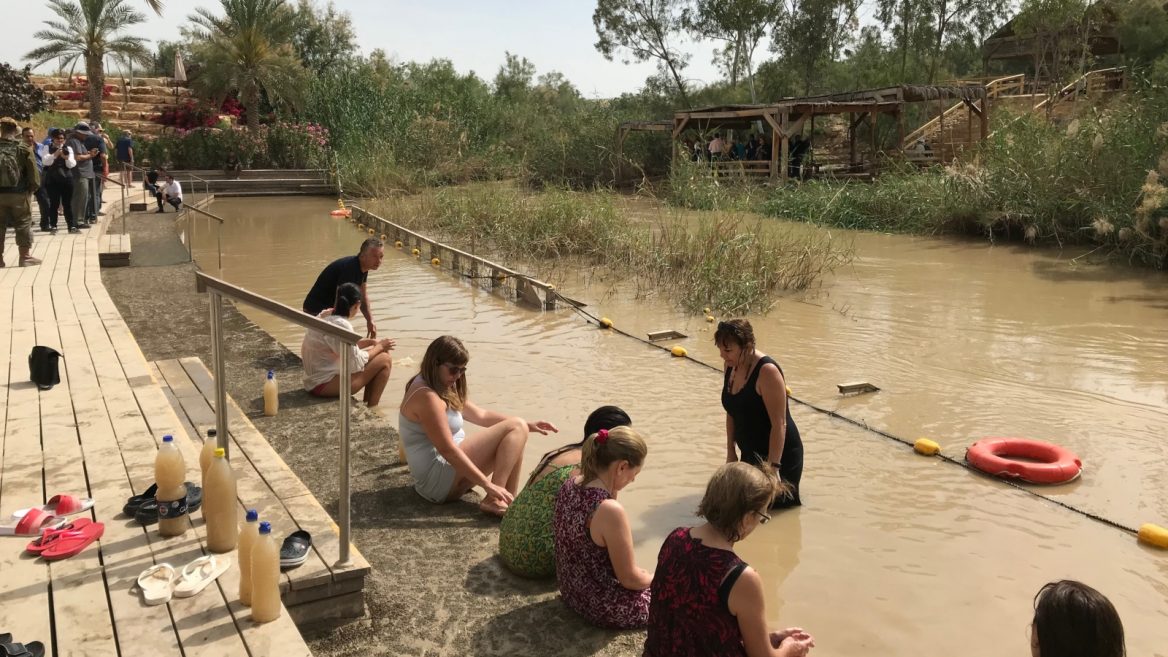 |
Easter Visitors Flock To Historic River Jordan

Comments
Post a Comment